
Keep Your Cool
AC Repair in Queen Creek, AZ
Serving Scottsdale, Phoenix, Mesa, Paradise Valley, and nearby areas



Keep Your Cool
Our Credibility
Guaranteed Or Your Money Back
The First Time
Service Available
No Pressure Sales
Queen Creek sits at the southeastern edge of the Valley, where the suburban grid gives way to larger lots, agricultural heritage, and a community identity built around space and quality of life. Its newer subdivisions — communities like Hastings Farms, Cortina, and Barney Farms — are filled with large single-family homes that demand high-capacity cooling systems operating under the full intensity of a Sonoran Desert summer. Compass Air Conditioning & Furnace Repair brings the expert service Queen Creek homeowners need to keep those systems running reliably from the first warm day through the last.
Queen Creek’s position at the metro fringe also means more dust, agricultural particulates, and wind-driven debris than communities closer to the urban core — all of which affect HVAC system maintenance requirements.
our services
Contact Us
Why Homeowners in Queen Creek, AZ Trust Us
AC Warning Signs That Queen Creek Homeowners Shouldn't Overlook
In Queen Creek, where homes are large and systems work hard, the cost of ignoring early warning signs is amplified. A high-capacity system under desert stress has less margin for developing issues than a smaller unit in a more moderate climate.
- A large home where certain wings or upstairs areas are consistently 4 to 6 degrees warmer than the rest.
- The system starting up with a loud clunk or hard jolt rather than a smooth engagement.
- Refrigerant lines showing signs of oil staining — a common indicator of a slow leak at a fitting.
- A utility bill that has increased noticeably without any change in household usage.
- The air from supply registers smelling dusty or stale even shortly after a filter replacement.
- Condensate dripping from the primary drain in unusual volumes during the monsoon season.
Acting on these signals before the peak of summer is the most effective way to avoid an emergency repair in July or August.

What Makes Queen Creek Homes Vulnerable to Specific AC Problems
Queen Creek’s semi-rural character and large home footprints create a set of HVAC stress factors that are distinct from communities closer to the urban center.
- Agricultural dust and fine particulates from nearby farming operations loading filters and fouling coils faster than in urban environments.
- Large two-story homes with extensive duct systems that develop pressure imbalances over time, particularly as duct seals age.
- High-capacity systems in homes over 3,000 square feet running at sustained load levels that stress contactors and capacitors through long summer seasons.
- Condenser units on large lots with variable shade conditions — some extremely well-shaded, others fully exposed to west sun all afternoon.
- Queen Creek’s position on the edge of storm tracks that produce high-wind haboobs, pushing significant debris through and around outdoor units.
Each of these factors has a predictable effect on system longevity — and each can be managed with the right maintenance approach.

How Compass Air Handles AC Repairs in Queen Creek
Queen Creek has grown rapidly, and many homes in communities like Encanterra, Sossaman Estates, and Queen Creek Station are still under their original equipment warranty. Compass Air accounts for warranty status and system age in every diagnostic.
- Manufacturer warranty verification before recommending parts
- Refrigerant type and charge level confirmation
- Smart thermostat integration and programming review
- Condenser pad leveling and clearance check
All findings are reviewed with you before any repair decision is made.
Inside a Typical Service Visit in Hastings Farms
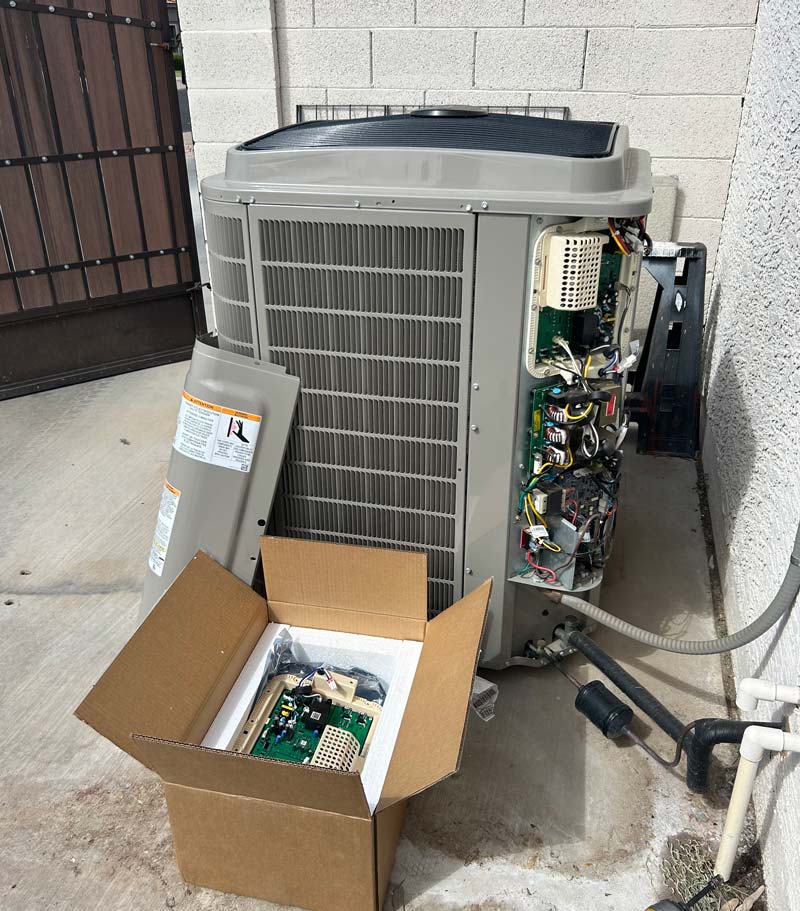
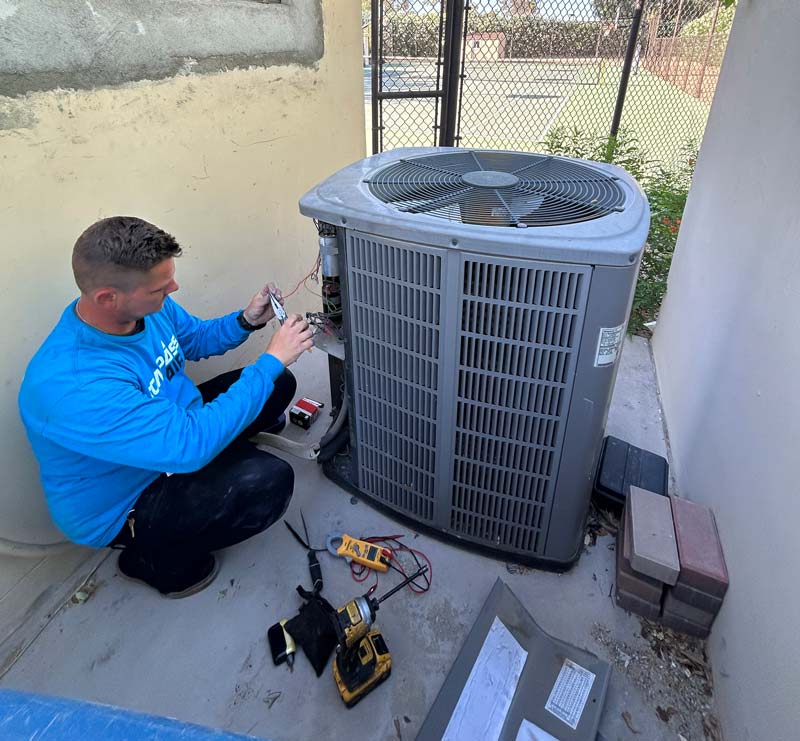
Ryan’s Hastings Farms home had been running two separate AC systems, and one of them — serving the upstairs — had been slowly losing ground for weeks. By the time he called Compass Air, the upstairs was holding at 84°F despite the thermostat calling for 76°F. The technician found the upstairs system was significantly low on refrigerant from a pinhole leak at a flare fitting on the outdoor unit. The fitting was replaced, the line was pressure-tested, the system was evacuated and recharged, and the upstairs was back to temperature within two hours. Ryan mentioned he’d been putting off the call hoping the issue would resolve. The technician explained why that wasn’t possible with a refrigerant leak — and left him with a clear maintenance plan for both systems going forward.
Why Queen Creek Families Choose Compass Air for AC Repair
Queen Creek families have put a lot into their homes — and they expect the companies they hire to bring the same level of investment to their work. Compass Air Conditioning & Furnace Repair delivers expert diagnostics, quality repairs, and a service experience that matches the standard Queen Creek homeowners hold for everything else.
- Skilled technicians who understand large-home HVAC systems and the demands of desert operation.
- Thorough evaluation that identifies real root causes before any repair is recommended.
- A professional, respectful service approach from start to finish.
- Quality repairs that hold up through the full demands of a Queen Creek summer.
When your home and your comfort matter, Compass Air is the repair partner Queen Creek trusts.
Areas We Serve
Compass Air Conditioning & Furnace Repair serves Queen Creek homeowners throughout the town’s growing residential communities, including Hastings Farms, Barney Farms, Cortina, Sossaman Estates, and the neighborhoods surrounding the Queen Creek Marketplace and Downtown area. We also serve the San Tan Valley communities adjacent to Queen Creek and the newer large-lot subdivisions on Queen Creek’s eastern and southern edges where the desert landscape transitions to more rural character.
Queen Creek sits at the southeastern edge of the Valley, with Gilbert and Chandler to the northwest — both part of the Compass Air service area. For homeowners in Queen Creek who want a repair company that understands large homes, high-capacity systems, and the particular demands of semi-rural desert operation, Compass Air delivers exactly that.
Frequently Asked Questions
Why does my large Queen Creek home have uneven cooling between floors?
Multi-story homes in Queen Creek often struggle with upper-floor cooling because heat rises, upper-floor duct runs are longer, and attic temperatures in large homes can exceed 160°F, adding significant radiant load through the ceiling. System zoning, duct rebalancing, and attic insulation upgrades are the most effective tools for addressing this systematically.
How does Queen Creek's agricultural dust affect my AC filters and coils?
Agricultural areas generate fine particulates from soil disturbance, crop harvesting, and wind erosion. This dust loads filters faster than in urban environments and can penetrate lower-MERV filters to accumulate directly on evaporator coils. Upgrading to a higher-efficiency filter and increasing inspection frequency during active farming seasons near your home is a practical response.
Should Queen Creek homeowners with large homes have more than one AC system?
Homes over approximately 2,500 to 3,000 square feet generally benefit from multiple systems or a properly zoned single system. A single unit trying to serve a very large footprint often runs at overcapacity, reducing efficiency, increasing wear, and struggling to balance temperature across distant areas of the home. If your current system can’t keep up, a capacity and zoning evaluation is worth scheduling.
How often should I replace AC filters in Queen Creek?
In Queen Creek’s semi-rural environment with more airborne agricultural particulates, monthly filter checks are more appropriate than the standard quarterly recommendation. During periods of active farming, high-wind events, or haboobs, filters should be checked within a few days of the event regardless of the regular schedule.
What's the best way to prepare my Queen Creek AC system for summer?
A professional spring tune-up that includes coil cleaning, refrigerant charge verification, capacitor and contactor testing, condensate drain flushing, and airflow measurement is the most effective preparation. Beyond that, clearing vegetation from around the condenser, replacing filters, and confirming thermostat programming covers the homeowner side of summer readiness.