

Most homeowners notice something is off with their air conditioner long before they call for help. A room that stays warm no matter what the thermostat says. A unit that runs constantly but never quite catches up. Sounds that weren’t there last summer. Air conditioner repair is one of the most common service calls for residential HVAC, but it’s also one of the most misunderstood. Knowing what’s actually happening inside your system — and when repair is the right call versus replacement — helps you make a confident, informed decision.
This guide covers the most common AC problems, how technicians diagnose and fix them, and how to know when your system has reached the end of a serviceable life.
Why Air Conditioners Break Down
An air conditioner is a system of interdependent components, and failure in one area puts stress on the rest. Most breakdowns don’t happen suddenly. They develop gradually — small inefficiencies that compound over time until performance noticeably drops.
The most common causes of air conditioner failure fall into a few categories: lack of maintenance, worn components, refrigerant issues, and electrical faults. Each presents differently, and each requires a different approach to repair.
Understanding the root cause matters. A technician who replaces a failed component without identifying the cause is setting you up for the same problem again in six months. Proper air conditioner repair means diagnosing the system, not just swapping parts.
Common AC Problems and What They Mean
The System Runs but Doesn’t Cool
If your air conditioner runs continuously without reaching the set temperature, the problem is usually refrigerant-related. Low refrigerant levels — typically caused by a slow leak somewhere in the system — reduce the unit’s ability to transfer heat effectively. The compressor works harder, the system runs longer, and your home stays warm.
This isn’t a fix-it-yourself situation. Refrigerant handling requires certification, and simply recharging the system without finding and sealing the leak only delays the next failure. A qualified technician will locate the source, make the repair, and restore refrigerant to the correct charge level.
The Unit Won’t Turn On
Electrical faults are a common cause of a non-starting AC. Tripped circuit breakers, blown capacitors, and failed contactors can all prevent the system from engaging. In most cases, these are straightforward repairs — component replacement on a system that is otherwise in good shape.
The more important question is why the component failed. Capacitors wear out with age, but they can also fail early due to voltage irregularities or an overworked compressor. A thorough diagnosis will tell you whether the repair resolves the issue or whether something larger is contributing to it.
Strange Sounds During Operation
Rattling, grinding, squealing, or banging from your air conditioner are not sounds to ignore. Each points to a specific mechanical issue:
- Rattling often indicates loose components or debris inside the unit
- Grinding suggests worn bearings in the blower motor or fan
- Squealing typically points to belt wear (in older systems) or motor bearing failure
- Banging can signal a loose or broken component inside the compressor
Left unaddressed, these issues tend to escalate. What starts as a worn bearing can become a seized motor. Catching mechanical problems early almost always results in a less expensive repair.
Weak or Inconsistent Airflow
Poor airflow through the vents is frequently a ductwork or air handler issue rather than a problem with the outdoor unit itself. Clogged filters are the most common cause and the simplest fix. Beyond that, disconnected or damaged duct sections, a failing blower motor, or a blocked evaporator coil can all reduce airflow significantly.
A frozen evaporator coil — which can result from restricted airflow or low refrigerant — is a particularly common cause of weak cooling performance that homeowners often mistake for a compressor issue. Proper diagnosis distinguishes between these causes and ensures the right repair is made.
Repair vs. Replacement: How to Think About the Decision
This is the question most homeowners eventually face, and the answer depends on more than just the cost of the current repair.
Consider the Age of the System
The average residential air conditioner has a serviceable life of 15 to 20 years with proper maintenance (Lennox, Carrier). A 10-year-old system that needs a $400 capacitor replacement is almost certainly worth repairing. A 17-year-old system that needs a compressor — the most expensive single component in an AC — is a different calculation.
Apply the 50 Percent Rule
A commonly used benchmark in the HVAC industry is the 50 percent rule: if the cost of a repair exceeds 50 percent of the cost of a new system, replacement is usually the more financially sound decision (Howard Services HVAC; American Mechanical Systems). This is especially true for older systems where additional component failures are likely in the near term.
Factor in Efficiency
Older systems operate at significantly lower efficiency ratings than modern high-efficiency equipment. If your current unit is running at 10 to 12 SEER (Seasonal Energy Efficiency Ratio) and a replacement system offers 18 to 20 SEER, the energy savings over time can offset a substantial portion of the replacement cost. A qualified technician can calculate the projected savings based on your home’s size and usage patterns.
When Repair Is Clearly the Right Call
- The system is fewer than 10 years old
- The repair addresses a single, isolated component failure
- The system has been well maintained and is otherwise in good condition
- Repair cost is well below the 50 percent threshold
When Replacement Deserves Serious Consideration
- The system is 15 or more years old
- Multiple components have failed in a short period
- Repair costs approach or exceed half the cost of a new system
- The system uses R-22 refrigerant, which has been banned from production and import in the U.S. since January 1, 2020, leaving only recycled stockpiles available — making it increasingly scarce and expensive to source (U.S. EPA; Trane)
What a Professional AC Repair Visit Looks Like
Knowing what to expect from a service visit helps you evaluate whether you’re working with a technician who is doing the job properly.
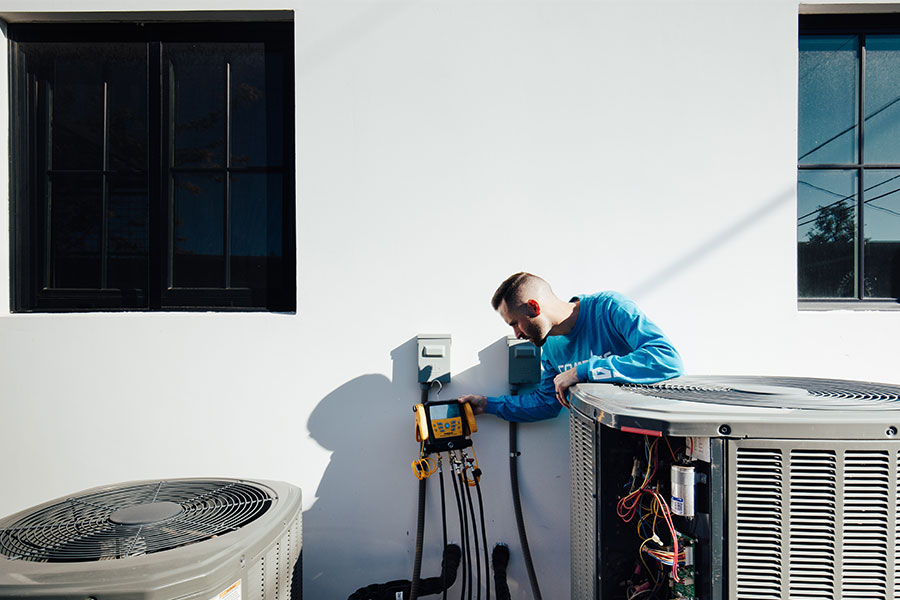
A thorough diagnostic visit should include a full system inspection — not just a look at the component that appears to have failed. The technician should check refrigerant pressure, test electrical components, inspect the evaporator and condenser coils, verify airflow, and review the thermostat and controls. This isn’t about finding more to fix. It’s about understanding the condition of the system as a whole so the repair holds and no related issue is overlooked.
Before any work is done, you should receive a clear explanation of what was found, what the recommended repair involves, and what it will cost. There should be no ambiguity about scope or pricing before the work begins.
After the repair, the technician should verify system performance — confirming that temperatures, pressures, and airflow meet the expected specifications. A completed repair isn’t just a replaced part. It’s a system that is functioning correctly.
The Role of Maintenance in Reducing Repair Frequency
Most air conditioner repairs are either caused or accelerated by deferred maintenance. A system that receives annual professional service — coil cleaning, refrigerant check, electrical inspection, filter replacement — is significantly less likely to develop the kinds of failures that lead to unexpected breakdowns.
Maintenance also extends equipment life. A well-maintained system running efficiently puts less strain on its components, reducing wear over time. The investment in a yearly tune-up is small compared to the cost of a preventable repair or a premature replacement.
If you’ve recently moved into a home and don’t know the service history of the HVAC system, scheduling an inspection is a straightforward way to understand exactly what you’re working with.
Choosing the Right HVAC Company for AC Repair
The technician you work with matters as much as the repair itself. HVAC is a licensed trade, and quality varies considerably between providers.
Look for a company that employs certified technicians, provides clear written estimates before work begins, and stands behind its repairs. A provider who takes the time to explain findings, answer questions, and communicate without pressure is one who is confident in their work.
Be cautious of any provider who diagnoses a problem without a full system inspection, recommends replacement on a system that warrants repair, or adds scope without explanation. A trustworthy HVAC company earns repeat business through results — not sales tactics.
Schedule AC Repair with Compass Air
When your air conditioner isn’t performing the way it should, Compass Air Conditioning & Furnace Repair delivers reliable HVAC services backed by professional diagnosis and skilled repairs. Our technicians arrive prepared, work cleanly, and communicate clearly at every step, so you always know what’s happening and why.
We focus on getting it right the first time. No repeat visits, no second-guessing.
Schedule a Visit or Request a Quote to get started.